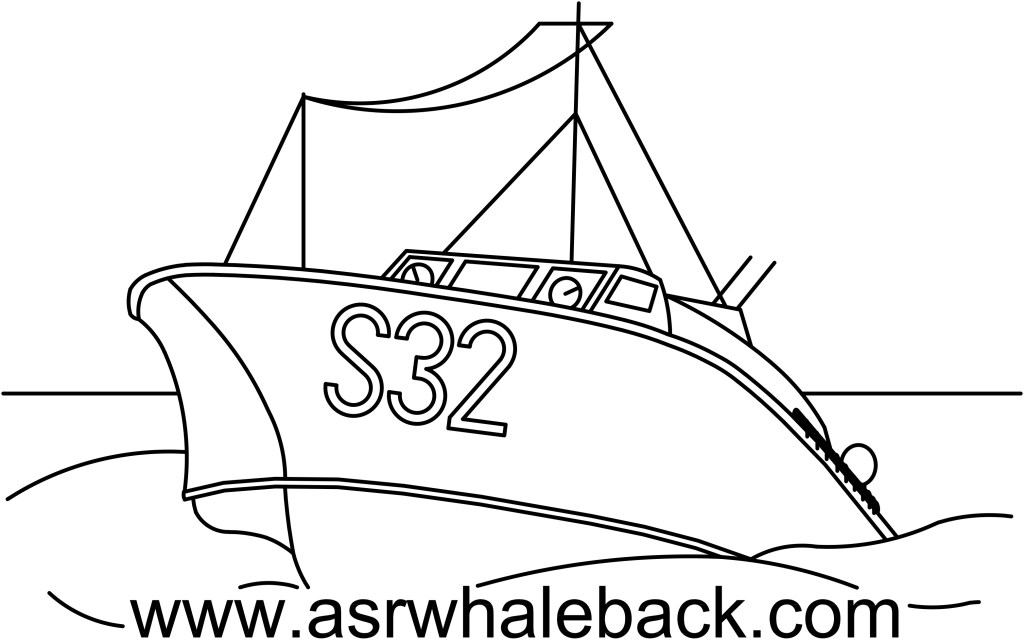
The following transcript was produced from the images at the bottom of the page from a document in the National Museum of the Royal Navy and a copy was kindly given to the project by Isaac Naylor
If you notice any mistakes in the transcript please email admin@asrwhaleback.com
12, Essex Road,
Stevenage, Herts
5th November 1944.
Sir,
I have the honour to submit the following report in connection with the activities of the M.A/S.B. Flotilla in two Dover Command for the years 1941-1944.
2. It is regretted that the records do not give much detailed information before the beginning of 1943, when the Flotilla acquired Ito full number of craft.
3. All craft were commissioned in 1941 and were allocated primarily to Air-Sea-Rescue duties both in the Dover Command and else where. A list of rescues in the Dover Command in shown in Appendix I.
During the period prior to the arrival of the rest of the Flotilla the available craft were M.A/S.B’s 23, 24, 31 and 38 which were based at Ramsgate and were operated by the Flag Officer Commanding Dover.
In addition to A-S-R duties these boats were employed in mine-searching for surface contacts, escort, survey and searchlight trials, etc. It is noteworthy that all four boats were fully employee just off Dieppe during and that’ M.A/S.B’s 34 and 32 each rescued a Spitfire pilot.
It was at about this time that M.A/S.B 31 was badly shot up by an enemy fighter as she was entering harbour — the Commanding Officer was killed and others were wounded.
4. At the beginning of 1943 the four boats operated from the Pens, Dover, for about six weeks — but in March returned to Ramsgate and were joined by M.A/S.B’s 25 and 29, which had come down from Grimsby. On the 11th April M.A/S.B. 38 arrived from the Clyde and on the 2nd May M.A/S.B 25 and 33 arrived from Lowestoft.
The Flotilla was now at its maximum strength and consisted of M.A/S.B’s 23, 24, 25, 26, 29, 31, 32, 33, 38.
The A.P.B. “Muskeeta” had worked out of Ramsgate and was included in the duty rota with the Flotilla until she was paid off at the end of July after a long period of unserviceability
5. The Flotilla now started working up as such and was assisted very materially by the encouragement and technical advice of the late Lieutenant G.D.K.Richards, D.S.C., Senior Officer, Motor Gun Boats Dover Command. Day and night manoeuvring exercises and shoots ver carried out in company and occasionally also in company with the Gunboats under Lieut. Richards.
- The Air-Sea-Rescue routine carried out at that time was:-
(i) Immediate Notice : One boat: Officers and crew having to remain aboard from Official Daylight until Official Dark.
(ii) 15 Minutes Notice: Two boats : Officers and crews to be within certain very restricted area and at easy call for duty.
(iii) 2 Hours Notice : Two Boats : Leave could be granted and small Jobs of maintenance could be done
(iv) 4 Hours Notice : Remainder of Flotilla operational : Formal maintenance and shore leave could be granted.
(v) Night Duty Boat (15 Mins. Notice) : One boat: (Duty was done/ alternative with R.A.F. H.S.L’s) : Officers and crew slept aboard : this duty usually preceded on followed upon immediate notice.
These duties were amended on the 12th August 1943 to read :-
(i) One boat. (11) One boat. (iii) 2 one hour. (iv) One or Two at four Hours and rest at Two Hours. It had been found that four boatswere nearly always required and hence the first Two hour boat was usually called upon and her Notice was purely theoretical. It may be remarked here that the Commanding Officers of the One Hour boats never took the HOUR too seriously and were usually available in about 15 to 20 minutes. The best effort of the Hour boats was four minutes!
7. In addition to the A-S-R duties the Flotilla continued its surveys, mine-searching and buoy servicing and also was frequently called upon to provide two to or possibly three craft for anti E-boat patrols in mid-Channel during the period from 4th April 1943 until 20th January 1944, when sufficient Motor Gun Boats became available. In respect of these night patrols it is worthy of note that officers and mon had frequently spent the whole of the day before at sea. This was especially hard on the one Telegraphist on each boat, but in no instance was a signal missed at night. Later a second Telegraphist was allowed in complement.
8. A noteworthy Air-Sea-Rescue was effected on the night of 17th-l8th August 1943, when the first complete Fortress crow as rescued by a Walrus aircraft, which had had to land in a bed seawey. She embarked all the ten airman, one of whom was badly injured, and was then unable to take off or even to taxi. At 1609 M.A/S.B 38(S.0.) and 33 wеге despatched to assist. Due to breakdowns in W/T and in V.H.F. in M.A/S.B.38, MA/S.D.33 established V.VF. contact with the Walrus as soon as she had been sighted and, with much difficulty took off the injured man and two others by floating down a rubber bomber dingy carried for that purpose. It was too dangerous to attempt more and the pilot, feeling he could now taxi, got under way with the M.A/S.B’s escorting at 4 knots for the forty miles back to Ramsgate which was reached at 0500.
9. The general reliability of the craft was good as there were, with rare exceptions, always at least five out of nine boats available. Prior notice having been received of the Invasion Exercise in September 1943, smoke floats had been obtained in quantity and all boats were serviced to maximum availability. Accordingly eight boats were available on the 31st August and an average of 7.77 boats were available daily until 14th September.
Smoke was laid daily to cover the Fleet mine-sweepers and, on 9th September, craft of the Flotilla were well in advance of the main squadrons of the Invasion fleets to screen them with smoke. During the period and at many other times also various of the Flotilla were straddled and others narrowly missed by enemy shore batteries. No damage or casualties were sustained.
10. 3rd September 1943. Four boats, M.A/S.B’s 38(S.0.), 25, 33 and 29 were detailed, with specialists from H.M.S. “Vernon” embarked, to inspect surface contact mines reported in QZX 1131. The sea was choppy and spotting was difficult and dangerous. One mine was spotted, inspected and eventually detonated by M.A/S.B 25.
lst October 1943. While M.A/S.B’s 38(S.0.),31, 34 & 23 searched two other minefields, M.A/S.B. 25 with the specialists aboard, went to QZX X1131 to endeavour to recover a mine. She was unable to accomplish this but towed in an obstructor for inspection.
11th – 13th October 1943. The advent of flat calm conditions enabled the sailing of M.A/S.B’s 38(S.0.), 26, 25, 33, 24, 23 to endeavour to explode es many of these mines as possible. Sixteen mines were definitely destroyed on the 11th.
M.A/S.B 29 replaced M.A/S.B 23 on the 12th and forty three mines were destroyed on that day. M.A/S.B 25 accounted for no less than twenty one mines (a world’s record?) and M.A/S.B 25 for 10 mines on this one day.
A final sweep was carried out by M.A/S.B’s 38(S.0.), 29, 23 on the 13th October when three mines were exploded; no more mines were spotted in a very extensive search.
On the 11th October one mine was cut, but not exploded, by an M.B. of the 5th Flotilla and was secured by the “Vernon” specialists who were embarked in M.A/S.B’s 38. They had previously tried to “lasso” a mine with a sinker attached with the idea of towing it in for inspection. The cut mine was secured and was taken in tow by M.A/S.B’s 38 who moored it inshore of South Goodwin buoy for inspection at low tide the following day.
The Commanding Officer of M.A/S.B.25, Lieutenant R.R.G. Callichan, R.N.V.R., was awarded the Distinguished Service Cross for this work and the Coxswains of M.A/S.B 38 and 26 :-
A/Ldg. Seaman G.T. Hughes and
A/Ldg. Seaman C.G. Smillie
were awarded the Distinguished Service Medal.
11. On the evening of the 27th October 1943, after a stenuous day on mine-search in fog, M.A/S.B’s 38(5.0.) and 32 were diverted to anti E-boat patrol. After receipt of a plot and, when nearing the position thereof, the Senior Officer decided to stop and listen for the sound of engines. By a misunderstanding M.A/S.B 31 did not get the signal to stop and a collision occurred. The bows of M.A/S.B 31 rode up over and became firmly wedged into the transom of M.A/S.B.38; fortunately the plot was friendly and the boats were able to make the twelve miles to harbour under their own power, they were out of routine until the 29th November and the 6th January 1944 respectively.
12. After continued poor running over a long period M.A/S.B 26 was taken in hand for a thorough refit by the Base staff at Ramsgate on the 30th November; the work was successfully completed exactly one month later.
13. 17th January 1944. M.A/S.B’s 25(S.0.), 24 and 23 were detailed to anti E -boat patrol and were later recalled by Dover, due to stress of weather. Due to reasons unknown M.A/S.B 25 and 24 ran aground on Goodwin Sands. (M.A/S.B 23 had lost contact and made harbour independently.) M.A/S.B 24 was able, after considerable efforts and after using a depth charge as an additional kedge-anchor, was able to get underway and enter Dover. M.A/S.B 25 had to be abandoned; the Officers and crew being taken off by the Walmer life boat.
No casualties were sustained by either craft in spite of the heavy seas now running.
M.A/S.B.25 was later salvaged and brought to Ramsgate under the orders of the Senior Officer, M.A/S.B Flotilla and the Commanding Officer of H.M.Tug” Lady Duncannon”. A copy of the full report by Senior Officer M.A/S.B. Flotilla to Flag Officer Commanding, Dover has been forwarded.
It is of interest that many hull and other fixtures were used on other craft and that the main engines, V-drive and auxiliary engine were all serviced and re-issued to boats and were completely satisfactory in spite of being under water for about a week in all.
M.A/S.B.25 was paid off as from P.M. 17th January 1944
The subsequent enquiry showed no negligence on the part of the Commanding Officer of either craft, but it was suggested that they should have had no hesitation in asking for a Radar fix.
14.A regular small duty each month was taking a G.P.O. engineer to service the telephones at the Themes estuary forts H.M.S. “Tongue Sand and H.M.S. “Knock John”. This involved waits at each fort and these were enlivened by watching practice shoots, an educational cinema show, instruction in Radar plotting of aircraft or possibly a visit to the well-equipped Wardroom!
Another job at which the Flotilla became somewhat adept was buoy servicing on behalf of Trinity House. This included fitting Large gas-cylinders and re-lighting buoys and also the re-equipping and maintenance of twenty-eight navigational buoys with air-sea Rescue Ladders, chain beckets and First Aid boxes. There was also an A-S-R float which had to be examined and serviced periodically.
15. Another Walrus aircraft was assisted by the Flotilla on 20th January 1944 when M.A/S.B 29 (S.0.), with M.A/S.B 33 in company, towed the aircraft, which had been damaged in landing on the sea to rescue a Thunderbolt pilot, the 16 miles to Ramsgate. The Walrus crew had to stand on the wing to retain trim while under tow, due to damage.
16. On the 14th March 1944 M.A/S.B 26 was the first of the Flotilla to be detailed to ‘survey’ work of a special nature. This word was used by the Flotilla Officers and ratings to retain the secrecy of the “Mulberries”, which were later to become our beach-head harbours at Arromenche. It was the Flotilla’s pride that the details or even the existence of the units at Dungeness were never divulged by a any member.
17. It was noteworthy that the hours at sea on A-S-R and other duties in early 1944 were over twice those of the same period in 1943. The reason became obvious as D day approached and D-1 day found the Flotilla able to supply seven out of eight boats to screen the largest convoy of men and material which had passed through the Straits in daylight since the fall of France.
An average of 7.4 boats out of eight were available daily for eleven days until short routine slipping was re-commenced. This efficiency reflects well on the engineers both afloat and ashore since there was no general warning os had been the case for the Invasion Exercise in the previous September. In respect of efficiency it may here be quoted that throughout June, July, August and September 1944 there were 5.4, 5.1, 4.5 and 4.8 boats in Category A each day, out of seven since one boat was nearly always on routine slipping.
18. From D-1 day until the 10th June M.A/S.B’s sere available both for smoke laying (for which they were now carrying two small C.S.A. sets and up to sixteen smoke floats each on a very clear day) and for A-S-R Duties. But smoke laying being so imperative and R.A.F. High Speed Launches being able to cope with the much reduced number of crashes over the Channel, the M.A/S.B’s were reserved for smoke laying almost exclusively. The hours were long and, during June, the weather was frequently bad and sometimes positively dangerous to handle smoke floats on wet and heaving decks, but in June, July, August and September the boats spent as much as 108, 118, 101 and 85 hours each at sea on an average, M.A/S.B 33 created a record in July in completing 167 hours at sea of which no less than 156 1/2 were engine hours and was unserviceable for only 2 1/2 days, which was the average for the whole Flotilla (if routine slipping be excluded).
19. The Flotilla remained as smoke layers to Channel convoys until the enemy shore batteries had all been silenced, except that assistance was given to the fitting of marker balloons to the mid-Channel A-S-R floats indicating the boundary between fighter aircraft zone and gun zone in the battle of the flying bombs. M.A/S.B’s were then to be seen at speed with one or, occasionally, two balloons flying at about 150 feet.
In this battle several boats had the pleasure of opening fire in anger at these fast targets, but without success; though one boat almost claimed one in more senses of the word than one! M.A/S.B’s 33 was returning to Ramsgate past Dover and opened up on a bomb just all before the shore batteries. The fourth Army shot was a direct hit (at least they claimed it!). The bomb would have passed directly over; the fuselage fell vertically and was watched with interest until the Officers and crew were aware that the explosive had separated and was carried forward by momentum to explode about 80-90 yards on the starboard bow and about 30-40 yards off the line of advance. Dover, having sighted this, signalled “Any damage or casualties” to which, fortunately, “No, thank you” was sent in reply.
20. The final job of note was the reversion to A-S-R duty for the Airborne expedition to Arnhem, on the 17th September and as long as the landings continued. On the 19th M.A/S.B 31 rescued seven men and M.A/S.B 33 rescued four men, each being the complete crew of the aircraft.
Seven M.A/S.B’s were engaged on seven days for an average duration of 18 1/2 hours in all, though M.A/S.B 24 did over 30 hours in all.
21. The boats were inspected with a view to being paid off, on the 6th September, and it was with considerable interest that the examining Officer, who had supervised their building, saw the good condition of the hulls and of the craft as a whole.
22. The last “employer” of the Flotilla was Commander wine-sweepers and Patrols, Dover, who had regularly used the craft since their first arrival in the Command. This job took two boats to within 1/2 a cable of Boulogne harbour and yet none of the Flotilla had the pleasure of entering any of those French ports which they had been so relatively close to in broad daylight on so many occasions while they were still German occupied.
23. Three inspections of all boats of the Flotilla were made.
Two by Captain of H.M.S.” Wasp” on or about 1st March 143 and 31st August 1943, and one by the Captain of H.M.S.” Fervent” in May 1944. Much useful information and advice was gained thereby.
Officers were detailed in monthly turns to act as Training Officers and a very full programme was carried through both in harbour and at sea. It is claimed that few, if any, flotillas any where could produce as high a percentage of semaphore exponents in Officers and ratings; and the station keeping of the Flotilla as a whole was an item of considerable local interest.
The “turnover” of ratings, if such a term may be used to indicate those who passed through any one boat in a given period, was very very good from a sea-training point of view. Senior Officer’s boat, for instance carried a crew of ten, but no less than forty-three names of those spending four days or more aboard were recorded in eighteen months.
24. On the 15th October 1944, at Divine service in H.M.S.” Fervent” and at the request of the Vicar of Ramsgate (The Revd. C. Bennett) the Senior Officer presented a panel from a cupboard in the Wardroom of M.A/S.B. 24 on which were mounted the wings of those ten pilots successfully rescued and four pieces of black crepe representing those who had died before being picked up out of the Channel. Amongst the former was Squadron Leader Gillam, D.F.C.and Bar; A.F.C. (now Group Captain). With the panel was the White Ensign then in use and it is intended that both shall be preserved, with a list of the names of those rescued by both M.A/S.B. 24 and the rest of the Flotilla, in the Victory Chapel in St. Georges Parish Church, Ramsgate.
25. The Flotilla paid off at Ramsgate and was ferried by its own Officers and crews to Poole, where it was handed over to H.M.S.” Tadpole ” acting on behalf of the Flag Officer Commanding Reserve Fleet. The trip of 155 miles was made in one day day by by each group — M.A/S.B’s 26(S.0.), 24 and 23 sailing on 11th October and M.A/S.B’s 38(S.0.), 33, 32, 29 and 31 sailing on the 21st October 1944.
Most of the Officers and crews were granted foreign service leave and there seems to be a very good chance that many of the personnel will meet and work together again in other spheres of Coastal Force activity.
A list of the Officers serving at the date of paying off is given in Appendix II.
I have the honour to be, sir,
Your obedient servant,
(E.C.D.Custance.)
Lieutenant. R.N.V.R.,
lately Senior Officer, H.M. M.A/S.B. Flotilla,
Dover Command.
The Commanding Officer,
APPENDIX I
H.M. M.A./S.B. Flotilla, Dover Command.
Air – Sea – Rescues Effected in Period May 1941 to October 1944
| Date | Name | Aircraft | Rescuer |
| 1941 | |||
| 16th June | F/O. Grant Goven | Spitfire | M.A/S.B. 23 |
| 21st June | F/O Stewart Charles | British Fighter | M.A/S.B. 24 & HSL’s 120 & 122 |
| 7th July | Sgt. Pilot C. J. Stuart | Ditto | M.A/S.B. 23 & 24 & HSL 147 & 127 & HSL 144 & 137 |
| 23rd July | P/Lt NovaK (Polish) | Ditto | M.A/S.B. 24 |
| 31st July | Sgt Pilot Boyd | Ditto | M.A/S.B. 24 |
| 27th August | Sgt Pilot Rutherford | Spitfire | M.A/S.B. 23 |
| 4th September | Sgt Pilot T.Coldwell | British Fighter | M.A/S.B. 24 |
| 17th September | F/O.J.A.Atkinson | Ditto | M.A/S.B. 31 |
| 13th October | P/O R.V.McNeil R.A.A.F. | Ditto | M.A/S.B. 24 |
| Ditto | Sgt Pilot J R Rithwick, RCAF | Ditto | M.A/S.B. 32 |
| 21st October | P/O D.C. Mitchell | Ditto | M.A/S.B. 32 |
| 23rd November | Sqdn/Ldr Gillam D.F.C and Bar, A.F.C. | Ditto | M.A/S.B. 24 |
| 1942 | |||
| 12th February | Lieut A.Williams F.A.A.* Petty Officer Clinton F.A.A.* | Swordfish | M.A/S.B. 23 |
| Ditto | Sub/Lt Kingsmill F.A.A. Sub/Lt Samples F.A.A. Air Gunner Bounce F.A.A. | Swordfish | M.A/S.B. 31 |
| 27th February | Sgt Pilot R.Batmen P/O Offord Sgt Pilot R.B.Madge Sgt Air gunner Winpenny | Havoc | Margate Lifeboat & M.A/S.B. 32 and H.S.L. 149 |
| 18th April | Sgt Pilot S.G. Napier R.C.A.F.* | British Fighter | M.A/S.B. 24 & M.A/S.B. 23 |
| 17th April | Flt/Sgt Messim | Spitfire | M.A/S.B. 24 |
| 9th May | Sgt Pilot Halliday R.A.A.F* | British Fighter | M.A/S.B. 32 & M.A/S.B. 24 |
| 1st June | P/O J. Richards R.A.A.F. | Spitfire | M.A/S.B. 32 & M.A/S.B. 23 |
| 6th June | Sgt. Pilot. W.E.Dunmore | Spitfire | M.A/S.B. 24 |
| 6th June | Sgt. Pilot A.Macpherson R.N.Z.A.F | Spitfire | M.A/S.B. 24 |
| 14th July | P/O Shakleton | Spitfire | M.A/S.B. 23 & M.A/S.B. 32 |
| 5th August | P/O Seydell, Belgian A.F. | Spitfire | H.S.L 127 & M.A/S.B. 31 |
| 19th August | Sgt. Pilot Evans | Spitfire | M.A/S.B. 32 |
| Ditto | Sad/Ldr W.G.G Duncan Smith | Spitfire | M.A/S.B. 24 |
| 27th August | Sgt. Pilot J.A. Hall | Spitfire | M.A/S.B. 31 |
| 3rd September | P/O McQueen | British Fighter | H.S.L 120 & M.A/S.B. 31 |
| 4th September | P/O Richard Betty U.S.A. | Spitfire | M.A/S.B. 24 & H.S.L 120 |
| 8th November | P/O G.C. Griffin* | British Fighter | H |
| 14th Dec | Three German Sailors from Channel Action on night 11/12th December | HSL’s 2547 & 120, Walrus Aircraft and M.A/S.B’s 31 & 32 | |
| 1943 | |||
| 26th January | P/O Burgess | British Fighter | Convoy Escort, M.A/S.B. 23 and H.S.L. 149 & 169 |
| 10th February | R.K. Walt, Royal Norwegian A.F.* | Ditto | H.S.L 127 & M.A/S.B. 31 |
| 25th July | Sgt. Pilot Munson R.A.A.F. | Spitfire | M.A/S.B’s 25, 38 and 26 |
| 17th August | 1st Lt. Lockhart 2nd Lt. Sherwin 2nd Lt. Williams Sgt Serafin Sgt Raphoon Sgt Husick Sgt Burn Lt. Woodburn U.S.A.A.C. Flgt Sgt Darden Flgt Sgt Cetnaroweski | Flying Fortress | Walrus in which they were taxied 40 miles to ramsgate and M.A/S.B’s 33 and 38. rescued by the same Walrus and transferred to M.A/S.B 33 before taxi-ing to Ramsgate. Believed to be first complete crew of Fortress rescued. |
| 1944 | |||
| 29th January | Captain Pretty U.S.A.A.F. | Thunderbolt | Walrus, which was damaged and was in turn towed into Ramsgate by M.A/S.B. 29 & M.A/S.B. 33 |
| Ditto | F/O Standen P/O Wilson Sgt Humphrey | Walrus | M.A/S.B. 33 |
| 3rd March | 2nd Lieut R.W. Foy U.S.A.A.F. | Mustang | M.A/S.B. 31 |
| 11th March | Ft.Lt. Stefan Kiewicz Polish A.F. | Spitfire | M.A/S.B. 33 |
| 11th April | Staff Sgt. R.K. Greenwood U.S.A.A.F. | Marauder | M.A/S.B. 24 |
| 25th April | Figt. Sgt. C.R.Ogden. Flgt.Sgt. C.C. Mitchell Figt.Sgt. 0.J.Pratlett Eng. Sgt. E.Tomason W/T Sgt N.Brook Gun Sgt. E.H.A.Boyle Gun Sgt, Frickleton | Lancaster | Located by M.A/S.B. 31 and 33, but rescued by Walmer Lifeboat due to shallow water |
| 8th July | Staff Sgt. Carlo Calioto* U.S.A.A.F. | Flying Fortress | M.A/S.B. 32 |
| 5th August | Pvt. Charles Lockhart of Darlington* | M.A/S.B. 33 | |
| 19th September | Flgt Officer M.D.Jones Pvt R Wood Pvt J.R.Paxton Pvt S.F. McKer All of U.S.A. Airborne Forces | Glider | M.A/S.B. 33 |
| Ditto. | F/O Cook T/Sgt Clark Cpl Ludwick Pvt Wilkick Pvt Kelly Pvt Murphy Pvt Colley All of U.S.A. Airborne Forces | Glider | M.A/S.B. 31 |
Those names marked with a star are those who were dead when picked up or who died before reaching hospital
 ASR Whaleback S32