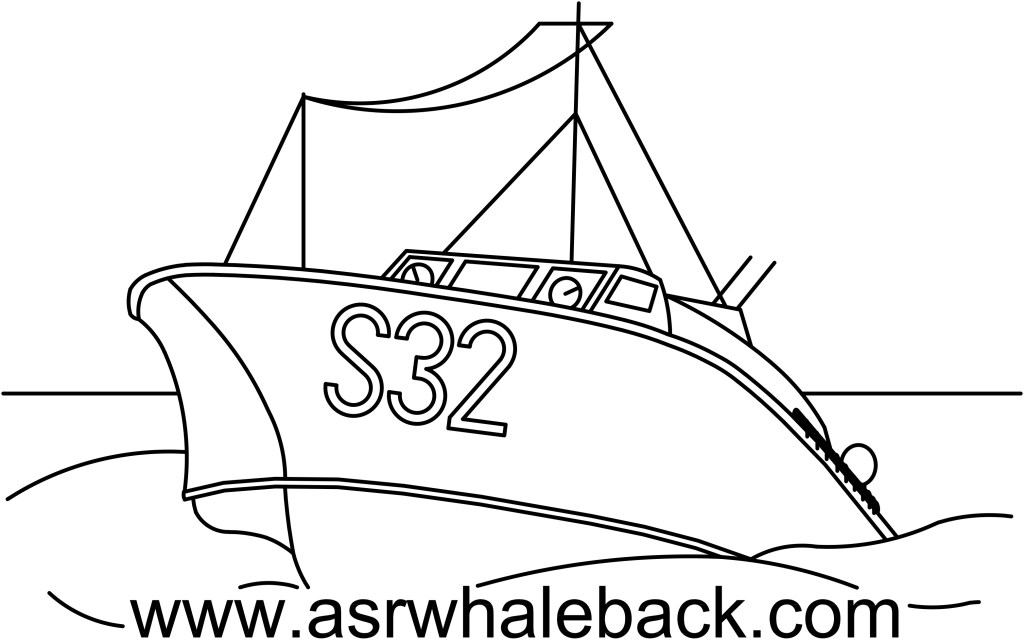
Much has been written about the work of Hubert Scott-Payne and his head Naval Architect George Selman at the British Powerboat Co, based at Hythe, Hampshire UK. The following is focused on our specific craft of interest, the 63ft Whaleback craft, used as base for the RAF Type 2 High Speed Launch and RN Motor Anti-Submarine Boat, both which served on Air Sea Rescue duties:
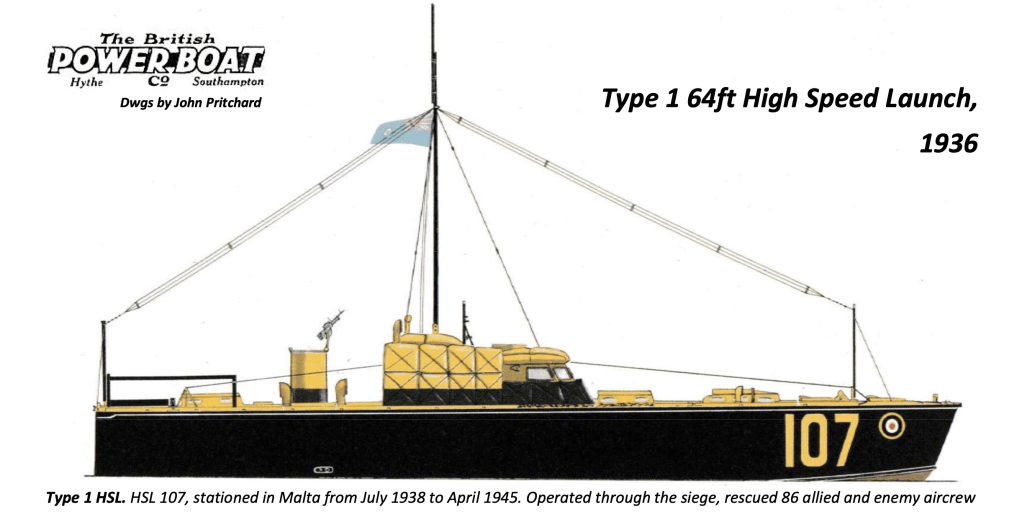
The 3 High Speed Launches used for RAF ASR duty in WW2, as designed and built by BPBCo:
BPBCoType 1 64ft High Speed Launch, 1936
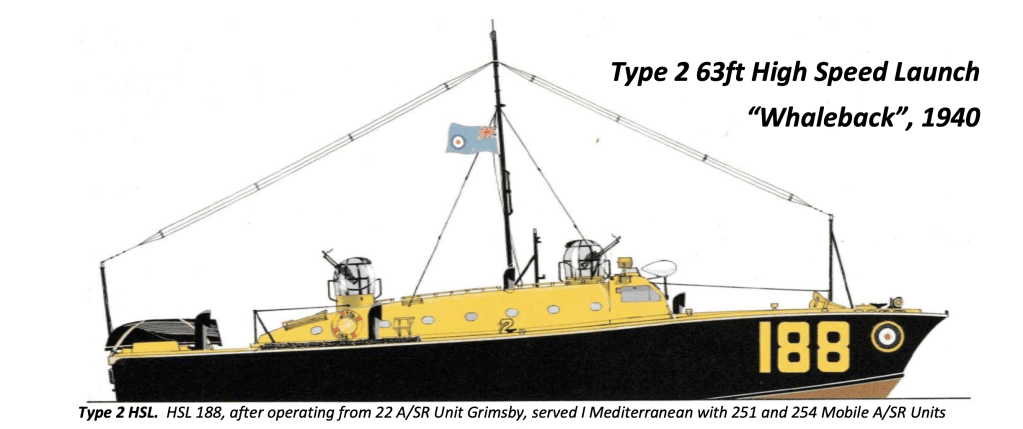
BPBCoType 2 63ft High Speed Launch “Whaleback”, 1940
BPBCo Type 3 68ft High Speed Launch “Hants & Dorset”, 1942
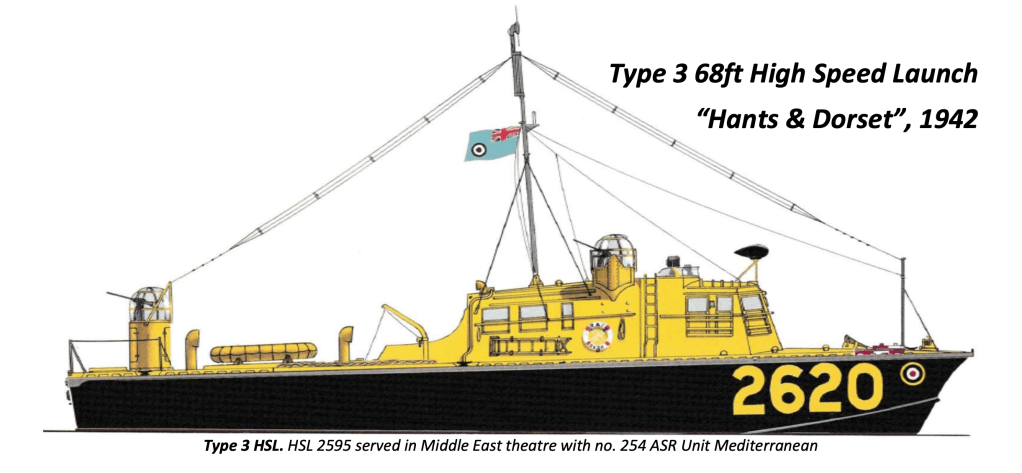
colour plate dwgs by John Pritchard
The RAF Type 2 HSL “Whaleback” the Spitfire of the Sea, as related to RAF ASR service:

In the late summer or early Autumn of 1941 new boats began to appear at No. 15 Air Sea Rescue Unit RAF Blyth and they instantly endeared themselves and the established crews of the old 100 class boats (HSL 102 and 118) eagerly transferred to them. Dad smiled happily when he recalled receiving 133 fresh from British Power Boats, still smelling of paint. She was, he thought, bang up to date, with enough performance to make his heart pound and, above all, she had a captivating beauty.

The distinctive curve of the deck earned these boats their nickname (Whalebacks) and gave them a visual appeal that was appreciated by everyone but had no real purpose. The story goes that George Selman, the chief designer, just happened to have shaped a test tank model that way and when ‘Scotty’ (Hubert Scott-Paine – founder of BPBC) saw it, he instantly recognised its selling potential. Despite Selman’s protest that it would weaken the deck, Scotty insisted it be retained. In a way both were proved right; everyone loved the look of the boats and the deck eventually had to be reinforced just where George said it would, admittedly to carry the weight of an extra gun. Fortuitously, the shape provided a low freeboard astern and eased the problem of getting survivors aboard.
Slightly shorter and slower than the 100 class (63ft rather than 64ft; cruising speed 30kts, top speed 39kts), technically speaking and in the eyes of the authorities they were a stopgap rather than a leap forward. The fractionally slower speeds and a slightly softer ride marginally reduced the crew’s ability to hammer themselves to death. Originally intended to function either as gunboats or as motor anti-submarine boats (MASB), they had a very low profile, which meant reduced headroom. In rough seas with the boat whipping the crew between deck and deck-head this was a problem.

If you were sufficiently agile, you could (just about) access all areas of the boat without going on deck (unlike the 100 class where the crews quarters (with its minimal kitchen facilities) had to be accessed over the open foredeck) . The fitters had to crawl on hands and knees to pass from the engine room into the sickbay. The crew had direct access to their living quarters from the wheelhouse but the Skipper and the NCOs had to perform gymnastics to get into their bunks. In the 100 class the skippers ward room had been fitted out with gleaming varnished mahogany and doubled as a sick bay. Now the high quality fittings had gone but there was a separate chartroom and a sickbay.
To provide an un-obscured foredeck the skylights above the crew’s accommodation had been sacrificed. There was not even a porthole left, so that the crew spent its time below in the light of dim yellow tungsten lamps. Air came in through inadequate mushroom ventilators that left everywhere below deck running in condensation and with the permanent smell of paraffin from the galley stove. The galley was, if anything, even smaller than on the 64 footers. It lurked behind a screen at the mid-ships end of the crew’s quarters in two feet of space pinched off the port side bunk. What could be achieved in this meagre and diminutive kitchen, with its single primus stove, was always a source of lively debate. The controversy raged on at Blyth. Most maintained it was virtually useless, but ‘Cappy’ Yields, while conceding that it was sometimes impossible to keep even a tied-down kettle on the stove, held to the view that it was perfectly adequate for most needs. To prove his point he issued an invitation to a dinner party to a mixture of supporters and antagonists. Dad was one, and Chubby Clayton another. In the dim yellow gloom of the crew’s quarters, admittedly bobbing gently at moorings, but with no more than the standard equipment, ‘Cappy’ produced a three-course meal that satisfied eight hungry men.
 ASR Whaleback S32