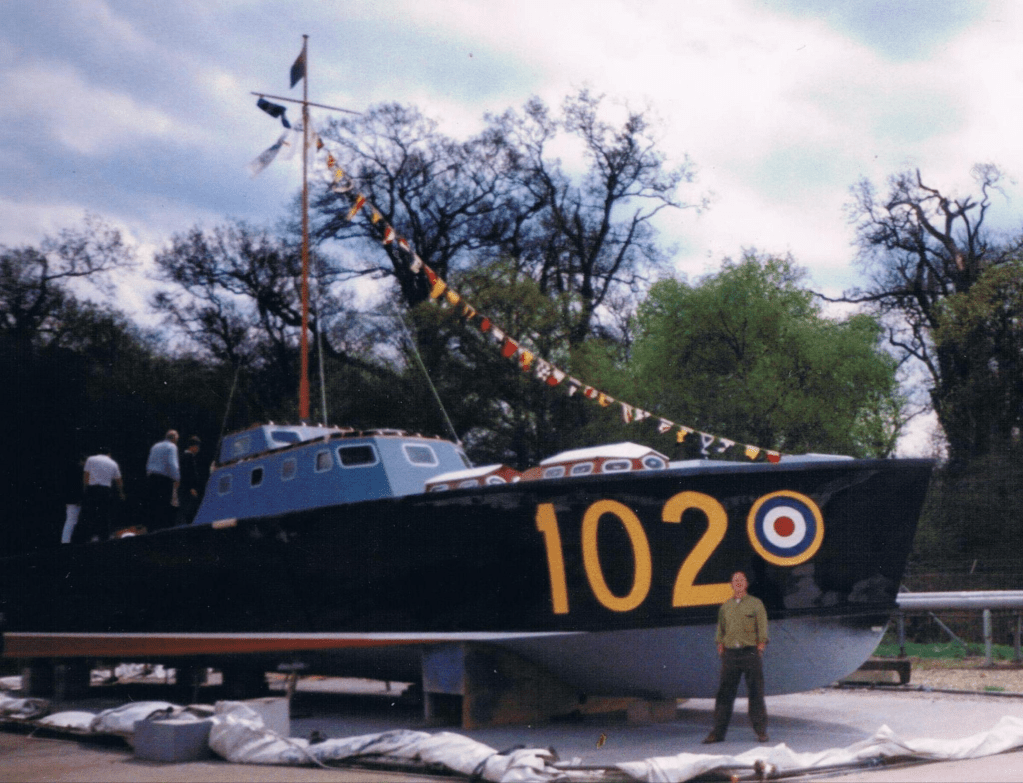
In March 1941, my future father, Edwin (Eddy) Lawrence (Laurie) Yorke (Yorkie), joined the crew of the RAF’s High Speed Launch (HSL) 102. She was one of only twenty-one (22 if you count the prototype) 64ft 100 class Air/Sea Rescue launches built prior to WW2 for the RAF by the British Power Boat Company (BPBC). 102 is the only boat of this class to survive until the present day.
My Dad was not one of those who would never talk about the war. We chatted at length and he gave me his notes to study:
Eventually it dawned on me that the boat that Phil Clabburn was restoring was not just an example of the type of boat my Dad had served on but actually one of the boats he had served on.
This prompted further research and as I questioned him about what I was reading (concerning the organization of the RAF Air Sea Rescue Service and the technicalities of the boats) a constant refrain began to sound:
‘Of course we (meaning the crews) weren’t aware of any of that.’
This article is an attempt to marry together two different types of viewpoint of HSL 102. One the bigger/official picture that can be found in books. The other is the personal day to day experience of my Dad, his family and that of his fellow crew members.
In early 1941 Eddie (aged 28) and Marie’s (aged 24) 4 years of married life had already been subject to several of the upheavals and traumas of service life. They had met (1936) and married (1937) in Bridlington, where Eddie, operating armored target boats, was steadily being bombed by his own side and Marie had given birth to two children, Michael (aged 4) and Peter (aged 3).
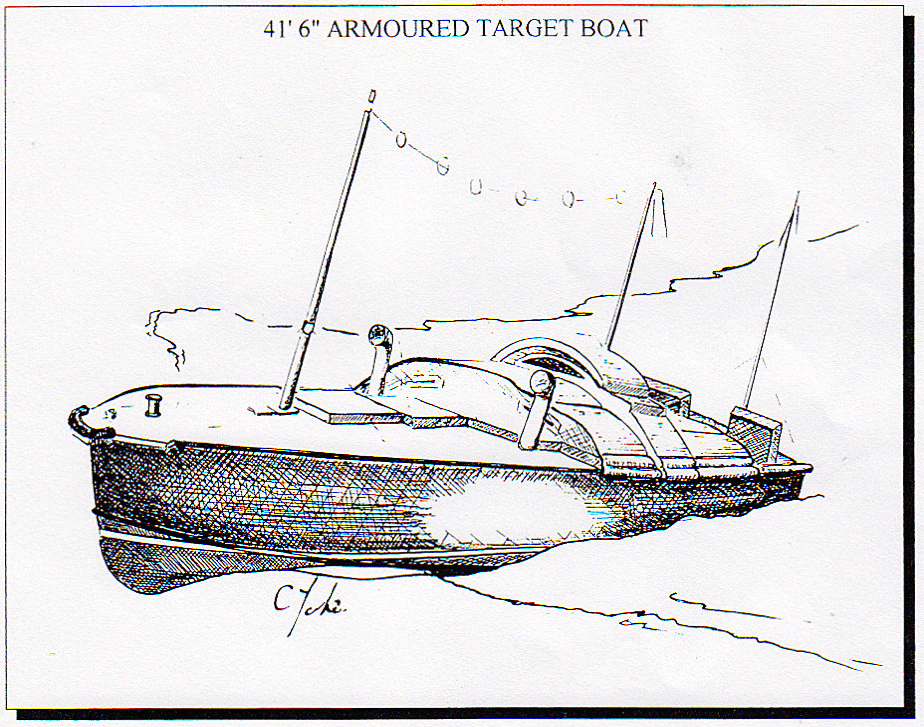
On New Year’s Day of 1940 Yorkie had transferred to Pembroke Dock (‘PD’) alone to take his new role as as the corporal coxswain of a Seaplane Tender:
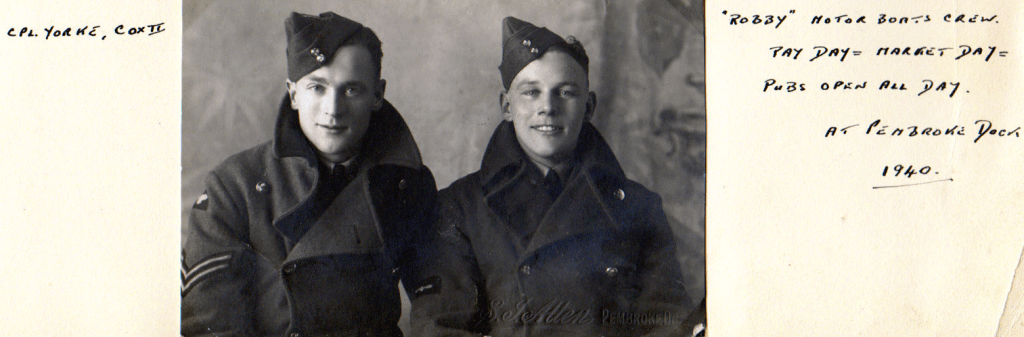
Marie and the kids) had been left behind, in Bridlington. They were not able to join him until March when Eddie finally found them accommodation. The family had been reunited for about six months when, in October, the RAF decided to send Eddie on a First Class Coxswains Course and as the course took place in Calshot, this meant a six-month family separation, which would include the coming Christmas. After the course, assuming he passed, another posting was bound to follow.
By way of consolation, while he was in Calshot and before Christmas his third stripe came through (he does not remember exactly when but it was definitely at Calshot: he remembered this because he recalled the hectic Christmas dance in the Sergeants’ Mess (lucky him, poor Mam)). Clearly that promotion did not depend on the results of the Course, which did not end until March 1941.

On successful completion of the course, he returned to Pembroke Dock and his family, but his feet were hardly below his own kitchen table before his posting came through. One evening, in early spring, he stepped ashore after keeping watch over the flying boat trots in Milford Haven and was told that:
’Calshot needs a Coxswain and your name is in the hat.’ He barely had time to think unkind thoughts about Calshot before his name had been drawn out. (had it been, he wondered, the only one in there?). His train staggered south carrying yet one more serviceman cursing his luck and as it staggered, he brooded on the difficult and depressing parting. Every sway of the carriage, every clunk of the wheels, was carrying him away from his little family. By the time he arrived, once again, at Calshot life seemed to have hit rock bottom.
In fact, they were all just about to get their dearest wishes granted. The posting turned out not to be to Calshot itself but to a specific boat that happened to be at Calshot undergoing a major refit: HighSpeedLaunch 102:
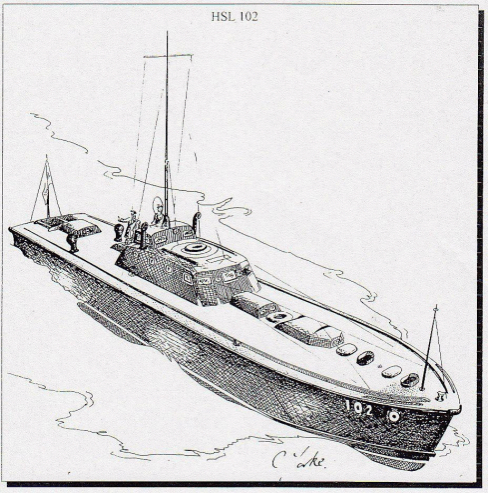
Although on a personal level the posting seemed to threaten separation from his wife and kids, professionally it looked exciting. Shortly after his marriage in 1937, while he was stationed in Bridlington, one of the 100 class boats (HSL 104) had visited the unit.
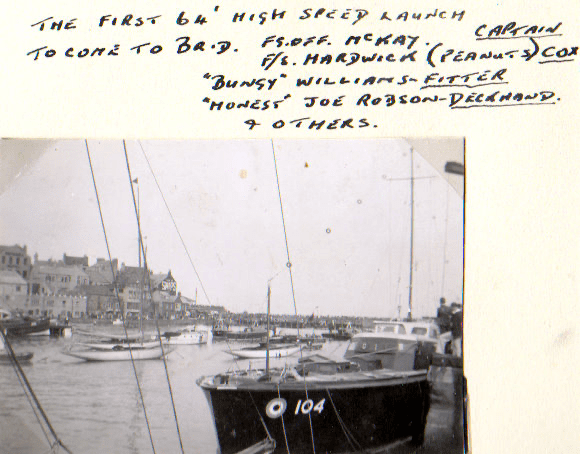
When she departed, she had taken away, as a new member of her crew, ‘Honest Joe’ Robson who had been their best man. Yorkie had waved Joe away with envy in his heart. The 100 class were the pride of the Marine craft section. These boats were at the cutting edge of the technology of the time. They were a direct and worthy descendant of and supplement to the 200 class Seaplane tenders that Aircraftsman Shaw (Lawrence of Arabia) had done so much to develop.
The 32ft 200 class Seaplane Tenders built by Hubert Scott Paine’s British Power Boat Company (BPBC) ‘hard chine’ hull design had revolutionized the design of small fast working boats and directly led to the evolution of the 100 class and arguably all the later small fast fighting boats of the Royal Navy and PT boats in America.
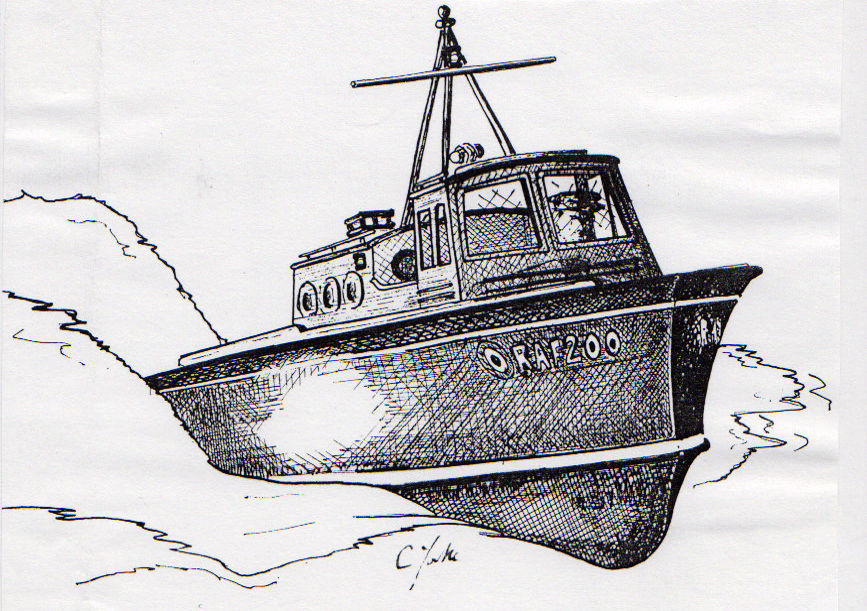
They had been a major step forward in the provision of rescue of RAF crews that crashed at sea. However, the steadily increasing speeds and range of aircraft had already clearly demonstrated the need for a larger craft that could travel faster, further, with room for a greater number of survivors and could keep at sea for longer. The BPBC had immediately set about designing a larger boat for the RAF.
The result came in 1935 when their prototype (RAF100) completed a proving trial of 373 miles from Calshot to Grimsby at an average speed of 36.2 M.P.H. Moreover, she offered: an officer’s wardroom/sickbay for four, a forecastle with bunks for a crew of eight, the capability to tow targets and the ability to remain at sea, even in relatively heavy seas, for 48 hours or more.
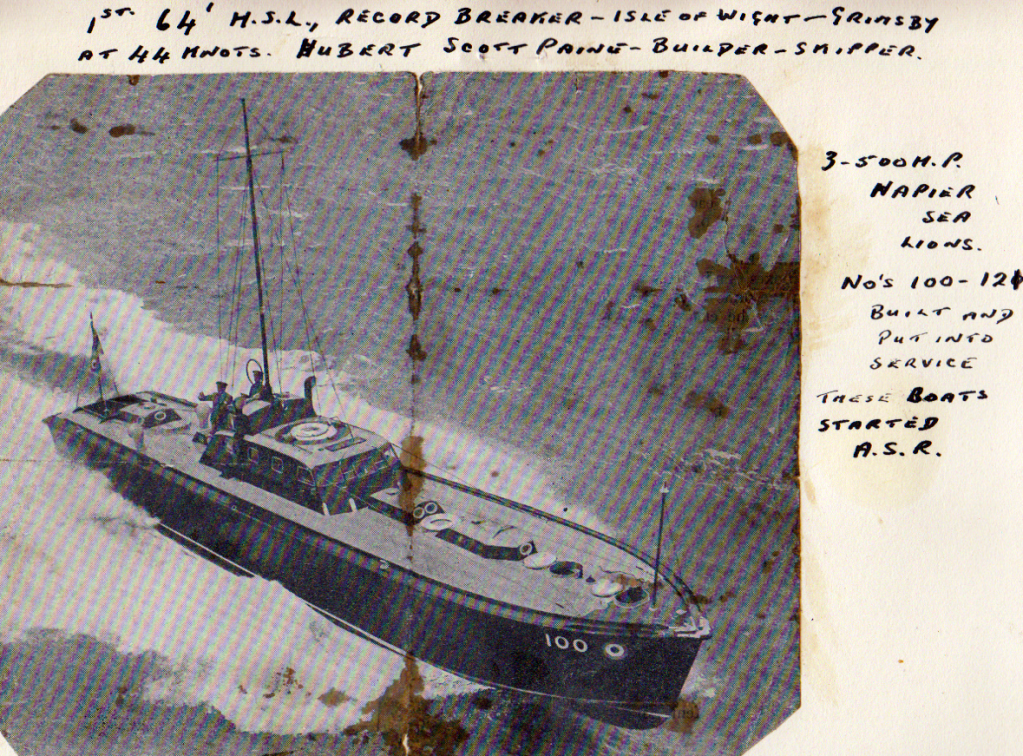

She created a stir and soon even the (until then only mildly interested) ‘lordships’ of the ‘battleship minded’ Admiralty began clamoring for boats of this type. The RAF placed an order for fourteen and then a further seven prior to WW2.
Much of their construction was based on Scott Paine’s (Scotty) experience building wooden-hulled flying boats and seaplanes with his old company: Supermarine. The hard chine hulls enabled boats to plane: force/lift itself up out of the water and skim the surface rather than displace the water and push it aside (a concept that, until S.T. 200, had been confined to racing or sporting boats). To do so, however, they had to be lightweight with powerful and lightweight engines. This pointed towards a marine version of an aero engine but with the threat of war, such engines would be difficult to obtain as the air ministry had prior claim on all the home industries output. Moreover, Scotty believed that it was important, these being military boats, that the engines be procured from reliable home (i.e. British) sources, (rather than say Isotta Fraschini) from Italy.
Scotty had already encountered similar problems when developing the 200 class Seaplane Tender and he had addressed it by forming a business partnership with Henry Meadows. For the 100 class Scotty directed the partnership’s attention to the Napier Lion engines which his former company had used to power the Supermarine floatplanes that, in the 1920’s, had won several Schneider Trophy contests and which he had already successfully modified to drive his record-breaking racing boat Miss England. These became the Napier Sea Lion engines and each 100-class boat was fitted with three, making them capable of thirty-nine knots (faster than a destroyer). Napier Sea Lions (which had started life as a WW1 tank engine) would continue to power new designs of RAF boats until the late 50’s.
In those pre-war days, few had anticipated an air war over the sea. The RAF’s original perceived need was for speed: ‘splash and dash boats’, which while based on areas of intense activity (such as bombing ranges or flying boat stations) could, on receipt of a ‘crash-call’, dash out, pickup and dash back, without (hopefully) being required to spend too long being thrown about on heavy seas.
In favorable circumstances this system could work well (notably in the narrows of the channel and later in wartime Malta where HSL 107 was to build a proud record). Wartime, however, would demonstrate the value of placing the boats in strategic positions in readiness for the intended activity.
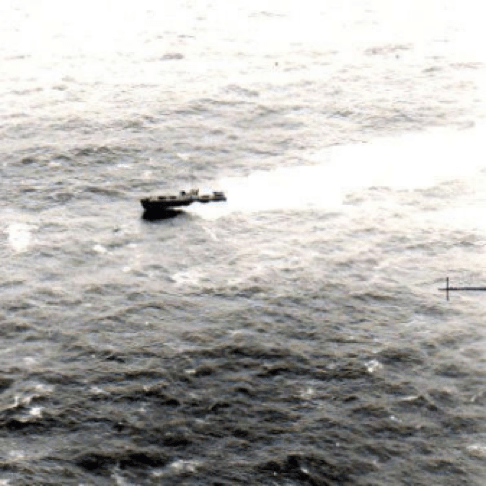
Then the boats were required to operate further and further from their home bases waiting/searching for long hours in demanding conditions. The lightness of their construction, (as new builds, only the bottom of the hull of the 100 class had a double thickness diagonal construction) proved to be problematic.
The sides (only a single plank thickness) then proved to be a weakness.
Much later my father, in a rare critical moment said:
‘Terming them High Speed Launches seemed to condition the way some skipper ran their boats. There was a tendency at the time for captains to run flat out and I have always been sure that calling the launches High Speed Launches had a great deal to do with this tendency’.
On one, pre-war occasion he told me he saw a 100 Class launch arrive home with her whole wheelhouse pushed back an inch or two by being run headlong into ‘green seas’.
Thus, in common with the rest of her class, by 1940/41 102 was showing signs of wear. Before the war, she had been based at Inverkeithing. There she had served as a bombing range safety boat and towed targets for aircrew training at her parent unit at Donibristle. She had also served as a rescue boat covering the North Sea from the Humber to the far North of Scotland. It had been hard work.
At the start of the war, she transferred to Blyth, as a rescue boat, and here well-meaning friends at the RN submarine base had treated her to a defensive armament of two depth charges. Later she was given the extra weight of a gun turret. Heavy seas and excess weight had strained her severely. Thus, in early 1941, when my father joined her crew, she was undergoing a major overhaul at Calshot. It may also have been now that it was deemed necessary to strengthen her by doubling her sides, for about half her length, from the stern forward.
When he joined her crew as her second coxswain Sgt. E. L. Yorke was not very aware or concerned with any of the above, he was impressed with and excited about the boat. But far better he found, she was not actually based in Calshot but in Blyth. Blyth was a short bus ride, on the ‘number 8 bus’, from his home in Whitley Bay. If they could find a place, Marie and the children could come up and be near to Granddad and Grandma Yorke.
The prospect of something like proper family life filled his cup with joy. Only very gradually did he begin to understand that for his boat and the rest of the 100 Class HSLs a brief but intense period as a scarce and precious commodity ‘a star in the spotlight’ was about to begin.
The RAF had long realized that, even with the help of the RN, the lifeboat service, the Merchant Navy, fishing boats and civilians its Air/Sea Rescue provisions were woefully inadequate. Therefore, in January of 1941 they initiated a new Air Sea Rescue service with the proud motto of ‘The Sea Shall Not Have Them’. It was to be a coordinated system that involved far more than boats but boats were a key component and HSL 102 was one of the few available.
At this point, the RAF had about 21 of the 100 class boats, 8 of which were overseas leaving 13 in home waters and only 10 of these were serving the East coast and Chanel. Consequently, a rapid expansion was about to take place. Most of that would be with new generations of boats but in the meantime, right now, they must begin by making the best use of what they already had: mainly the 64 foot 100 Class Launches backed up by all its other boats, none of which were entirely suitable for open water rescue being either too slow (pinnaces) or too small (seaplane tenders).
At Calshot Yorkie found himself, in common with the rest of his crew, smitten by the boat. To their eyes she looked great, a magnificent ‘Boy’s Toy’, a ‘Spitfire of the Sea’. Amid the bustle and confusion on Calshot Spit, they kitted her out with pride and took her for a few trial runs amongst the teeming traffic of Southampton water and the Solent, shaking her down in preparation for the 400 mile trip home.
The skipper was Flying Officer ‘Tommy’ Thompson (ex Merchant Navy). He suffered from ulcers and, at sea at least, lived off tins of condensed milk. He was, said Yorke:
‘A good skipper and a mischievous blighter, we had some fun with him’.
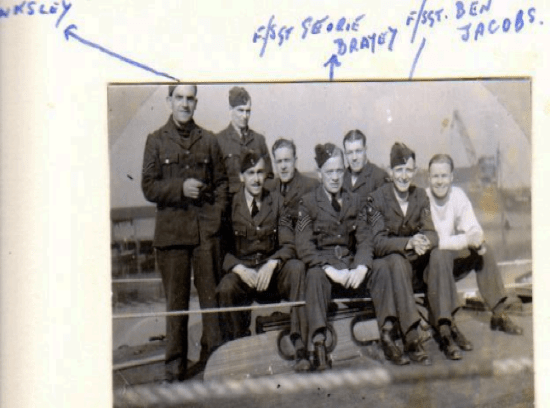
The first coxswain was Flight Sergeant Ben Jacobs whose alertness and swift responses were soon to save the boat. Their fitter (Engineer), was Sergeant Joe Curry. ‘Joe’ was one of ‘Trenchard’s Brats’: a pre War RAF engineering apprentice, the cream of the other ranks. Better fitters than Joe were hard to find (In the rapid build up of Air Sea Rescue, apprentice trained engineers were to become an increasingly rare asset and engine breakdowns on the boats frequent. Many blamed the engines and many others the lack of proper training. The engines remained in service on RAF boats for many years after the war, so take your pick). The remainder of the crew (at this stage normally around eight), were less permanently attached to individual boats and at Blyth would find themselves shifted from boat to boat as needs dictated.
Preparations complete and confident with the boat, they set out for Blyth in brisk weather, at speeds of around thirty knots. They hammered along in a way that had become ‘fairly’ standard for these boats but would have shocked landsmen and not a few big ship seamen. Other boats pushed through the water, shouldering it aside, these slammed from wave top to wave top, often airborne. At one moment, they would be thrusting their crew towards the deck-head; at the next, they would fall away, leaving the men for a moment weightless, before they dropped heavily to the deck. (Think of modern offshore powerboat racing but without crash helmets, roll cages, safety straps, or indeed seats but with a harder ride). Crews quickly developed a characteristic stance – feet wide apart, for stability; bent at the knees, to cushion the shocks; hunched at the shoulders, to avoid, as far as possible, hitting the roof. It was a punishing, sickening motion to which even long-term seamen found it difficult to become accustomed. Men who had not been sick for years on other vessels would often take months to get used to these boats. Some never did and had to be posted away, others, amazingly, just put up with it.
One of the limitations of these boats was the damage they could inflict on themselves, but far more serious was the fatigue and damage they inflicted on their crew. Most of this crew didn’t care. They felt their boat was at the cutting edge and loved its speed, dash, and glamour.
Three hours into the trip they were in a happy relaxed mood and began to anticipate putting in to Dover for a meal in comfort. As they approached the port, Yorkie had occasion to visit the N.C.O.s quarters at the stern.

Experience had shown them to be, at sea, a cold and uncomfortable place, so they were using them as a storeroom (the N.C.O.s were bedding down on any convenient bunk forward). No one, therefore, had had cause to visit them, or to look into the open cockpit behind them since they had left. He started down the ladder and heard the slop of water, stepped off the bottom and found the floorboards awash. They sounded the bilges and found two feet of water, which gave them an even better reason than a peaceful meal to call in to Dover. Safe alongside, an anxious inspection of the hull revealed that along her port quarter for nearly twelve feet forward of the transom, screws were sticking out up to one and a half inches from the planking. The skipper requested a hammer be brought, and when it arrived, passed it to Yorke, and ordered him over the side to make his contribution to her refit.
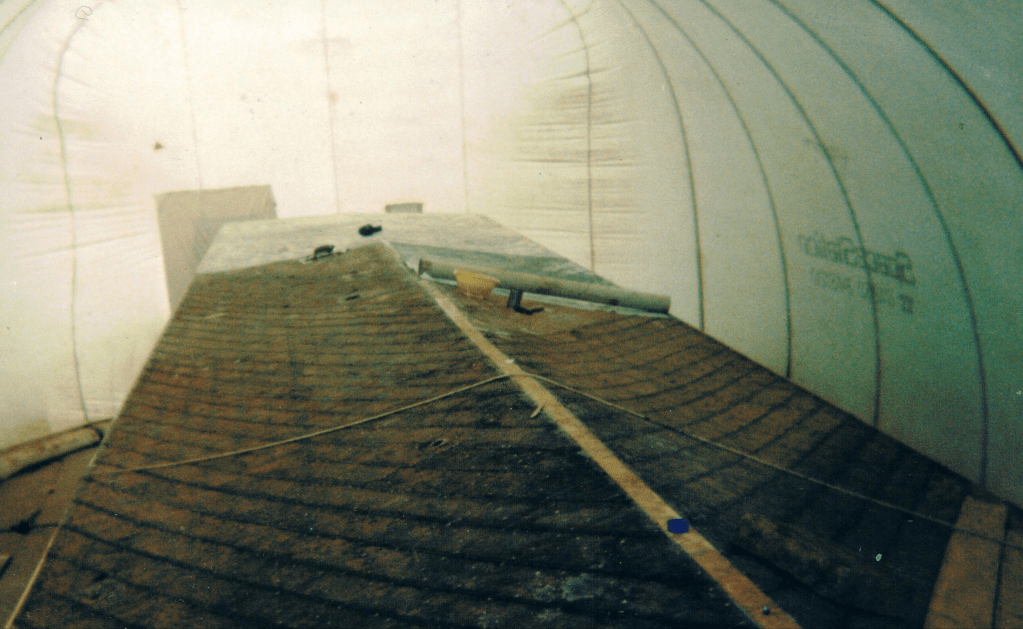
(When my Dad and I visited 102 during the course of her restoration by Phillip Clabburn and told him this story he presented us with a handful of the same brass screws that he had removed from her stern. Each screw he replaced he secured with epoxy resin. He then gave the hull a complete covering of G.R.P. I still have my screws.)
The rest of the crew must have had more confidence in his boat building skills than he felt, after Dover, they hammered on again with very little, if any, concession for the state of the hull. Between the South and North Forelands the sea conditions moderated to an oily swell. About two thirds of the way between the two with the Skipper at his lookout position, Ben Jacobs at the wheel and Dad at the chart table, a cry came from the bow lookout of:
‘Mine, on the starboard bow!’
Ben may have caught a glimpse of it, for his reactions were perfect. He swung the bow, first to starboard – towards the mine – and then away to port, using the bow wave to push the mine away. It worked, just. As Yorkie stared through the chart house window, he saw four of the mine’s horns bobbing by. They had passed so close that the body of the mine was hidden from him by the hull.
They spent the night in Grimsby, threading their route in and back out of the Humber, through crowds of shipping that was waiting for convoys to form, and even more carefully picking a way around the forests of funnels and masts of sunken ships that had not made it.
Only one other incident on their journey to Blyth remains in his memory. Beneath the cliffs of the Yorkshire coast, while the skipper supped steadily on his tins of milk, one of the deckhands struggled ‘manfully’ for hours to produce a meal. The circumstances were difficult; he quickly realised that keeping a pan on the hob was impossible. Left on its own it was soon bucked off by the boat. If he held it in place the contents were deposited on his hands, not a great danger – they were never in the pan long enough to get hot but ultimately pointless. He settled in the end for baked potatoes, which, by cutting in two he managed to half bake. As a final
act of culinary inspiration, he sprinkled them with cheese. It may not sound much to us, but to those hungry “Webfoot” airmen it was a culinary delight.
It was unusual at this time for the boats to carry much in the way of food. It only became common after one boat (HSL 108) went U/S in the German Bight. The crew were adrift for several days before the half starved crew were captured (perhaps rescued is a better word) by the Germans. News of this eventually filtered back and the boats began to carry rations, in the form of self- heating soups etc. In the mean-time Dad always carried packets of hard tack biscuits, in his duffle coat pocket, which he nibbled constantly to keep down sea sickness. 102 was now about to begin a period of arduous and heroic service in which she would be instrumental in saving many lives.
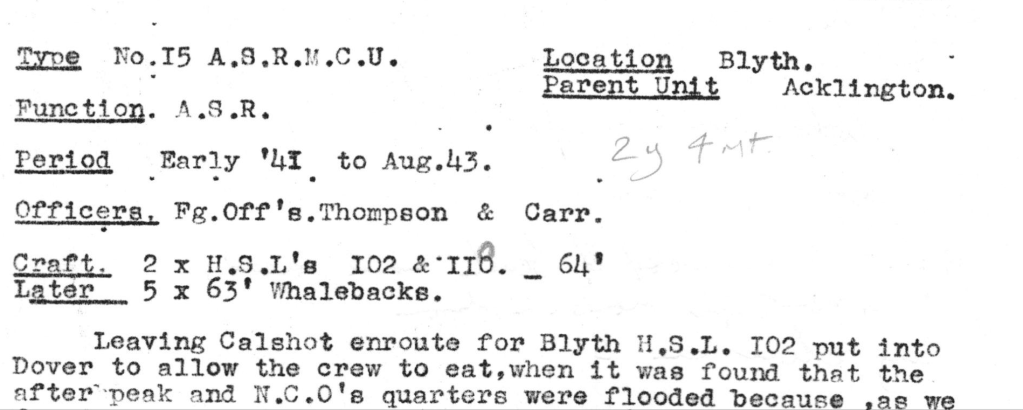
At Blyth they joined 102’s sister ship 118 and Flying Officer Thompson took over command of the unit (No. 15 ASR) from her skipper, Flying Officer Carr. The two boats now worked day and night – twenty four hours as first duty boat and twenty four as the second. When a ‘crash call’ came, the first duty boat was expected to be away in less than ten minutes, the second duty boat within an hour. They were therefore provided with convenient moorings. Sheltered in a corner, about seventy yards from their billet, they tied up to pontoons that rose and fell with the tide, doing away with the constant chore of adjusting mooring ropes. You could even check your compass while still moored, by taking a bearing on a church spire about a mile and a half away. The billet was a cozy little hut, in which 118’s crew were nicely established. A little reluctantly, they budged over and later, as new boats began to arrive, larger accommodation was built. If they learnt to share their home neither boat ever learnt happily to share ‘pickups’. It was common to all Air Sea Rescue Units that all the boats competed with each other to be fastest and most reliable but not necessarily the smartest. What ASR crews aspired to was to be ‘best boat’ and ‘best boat’ meant most ‘pickups’. With only two boats, they were never off duty except when on leave. Even when the number of boats was built up to five there was little relief, as some boats would be detached to Hartlepool or Aberdeen.
They did however get occasional quiet spells in which they could snatch off a day. On these precious days, Dad would catch the bus to Whitley Bay, where Mam and the children were now living in a flat in Clifton Terrace. Mam, Michael, Peter (and, eventually, me), were to live there until 1948.

Relative to their colleagues further south in the Channel around ‘Hell Fire Corner’ the Blyth boats faced enormous handicaps. ‘Down South’ the boats were operating in conditions much nearer those they were designed for: a high-speed dash, a more or less prolonged search and a high-speed run home. ‘Up North’ the weather was worse and there was a lot more sea. Most of the searches were long range. On one occasion, there were no less than five dinghies in the sea off Flamborough Head (90 odd miles away).
The most effective searching was done by aircraft (initially by those of the downed aircrafts own unit and later by those of specialized squadrons). If survivors had been located (hopefully in a dinghy) the launch would then be directed towards it by radio. Navigation was by ‘dead reckoning’ and fixed points like Flamborough (at least a 3 hour run from Blyth) were thus often used as ‘jumping off’ points (useful position fixes to be reached even before a for a run towards the actual search area to which they had been directed, which might be another 100 miles or more away). By the time they arrived however the dinghy, if there was one, could have drifted miles from the estimated position indicated. Calculating drift was more of an art than a science and it was difficult to see far from a low boat, so a search pattern would be initiated. Perhaps the best that could be hoped for was an aircraft circling above their target as a marker. Otherwise, an aircraft having located the dinghy may have sent back a decent radio fix. Too often, however, they were directed to a last known or even estimated position. The problem of finding a dinghy was somewhat alleviated later in 1941 when a German dinghy radio was captured enabling us to reverse engineer (copy) it. From then onwards, provided everything worked as it was meant to, it was possible for the dinghy to send out their own radio fix, onto which launches could be homed.
HSL 102 and 118 may not have operated under the enemy guns, as the boats down South sometimes did, but they experienced danger of a different sort for smaller
rewards. Rather than fire from enemy aircraft or coastal batteries, the Blyth boat’s major threat was the sea itself. Instead of relatively short intense periods of danger, they faced long hours of being slammed up and down and side to side as the boat skimmed the waves like a pebble thrown in a game of Ducks and Drakes. Once, off Hartlepool, in a nor’easter, in the company of 118, Dad looked across and saw she was airborne, clean out of the water, a sixty-four foot length of grey sky beneath her keel where the darker grey of the North Sea should have been. When she eventually came down, she lost her central propeller and stripped off the bonding strips that were attached to the hull (to free her of static). At the time they had only been doing about ten knots! In spite of this there was never any trouble getting a crew. Rather, it was a question of looking around to find out how many extras had sneaked aboard in the hope of being in on a pick up.
They could sleep at night, but only after laying out their clothes in readiness to put on over their
pyjamas. This practice could be a source of embarrassment, as when a boat left Blyth but then had cause to put into Hartlepool from where some members of the crew were obliged to return to Blyth by train. Unfortunate red-faced airmen could then find themselves on the platform of a railway station in very irregular uniform, their pyjamas showing at the ankles, wrist, waist and neck.
Uniforms, never having been intended for use at sea, were a problem. They faded, the buttons tarnished and they certainly were not waterproof or warm. Eventually submarine sweaters became standard and after D-Day, a grateful Eleanor Roosevelt sent them all a present of a flying jacket (one each, I mean not one between the lot of them). In the mean-time the airmen ‘sailored’ on, made what modifications they could and dodged the S.P.s (Service Police) who might have arrested them for being improperly dressed).
On one such occasion, they stepped ashore from a call-out that had lasted twelve hours. They had concluded a futile search only to be caught off Sunderland after dark as an air raid was in progress. That meant that they had to heave-to until it was all clear (under way their wake would have signposted them to the enemy as effectively as trailing a broad white arrow). For a frustrating hour they lay off Sunderland and rolled. Then outside Blyth, when they should have been in sight of home, fog like ‘pea-soup’ came down. The skipper ordered Dad to ‘splice the mainbrace’. He tried to, God knows he wanted to, but where, on other occasions, he would have been beating airmen off with a stick, now he found that before he could get around with the rum, half of them were asleep. Should he wake them or leave them? Mostly he left them. The fog eventually thinned the following morning. Frustrated, tired, hungry, wet and salt encrusted they crept in, tied up, and climbed the pier. Here they bumped into a group of Wrens who took one
look at them, collapsed into a fit of giggles and chorused: ‘Cor! Look at the Brylcream Boys.
No. 15 Air Sea Rescue Marine Craft Section shared their Blyth base with Elfin, a Royal Navy Anti- Submarine Base but not as equal partners, the RN was always the ‘Senior Service’. It led to a great deal of inter-service rivalry but at least it meant that the RAF crews were able to draw some rations that would otherwise have been difficult to obtain.
Elfin’s role as a submarine and minesweeper base was sufficiently different from the RAF’s to avoid direct competition here; at Blyth, it was mostly friendly. Elsewhere, notably on the south coast bases, where the RN Rescue Motor Launches (RML’s) competed directly with RAF Launches for pick-up’s, rivalry was more intense and the RAF’s ASR crews often smarted under the Senior Service superior attitude. At Blyth the two services rubbed along in a spirit of mutual leg-pulls and putdowns. If the ‘Andrew’ pretended to resent these part time amateurs, ‘the Little Boys in Blue’, playing around on ‘their sea’, the ASR Boys rested smug in the knowledge of their faster boats. Whenever the Navy ever hit a sore point, they had only to remind them of the HSL Skipper who, while taking advantage of his shallow draught to skim across a minefield, found his launch rapidly overhauling a Cruiser. The Cruiser signaled him enquiring:
‘What are you doing in a minefield?’
The launch skipper is said to have sent back:
‘Close on 40 knots, how about you?’
In its turn, the Navy claimed smartness as their prerogative but while the RAF boats might not have passed for a fleet review, they were by no means scruffy. Unlike aircrew, boat crews maintained their own craft and in rare spare moments, some painting was done. The paint could be stored in the forward lookout (a dark little hole that had become to be used as a chain locker). The hatch was customarily closed before putting to sea and once on one of the boats it was slammed down on top of an unfortunate deckhand. Poor soul, when the hatch
cover went down, he had the lid off a tin of paint. Unable to replace it he spent a bumpy trip down there with his ‘gallon of grey’ and came up a shadow of his former self. The deck hands should have been saved from the constant chore of polishing brass by the boat builder’s foresight in specifying that all brass fittings be chromed, but 102’s must have worn off because Ginger Ward took all hers to a local factory to be re-plated, free of charge. This doubly enhanced Ginger’s reputation, once as a scrounger and again for being too lazy to polish brass.
At this early stage, submarine officers were inclined to beg for:
‘… a trip in your little speed boat’.
Then the RAF skippers would bite their tongues, smile consent, and carefully pick a suitable day for the ‘little treat’. The results of these ‘inter service liaison exercises’ all tended to bear a marked similarity to the one Dad remembers best. On that day, 102 embarked a happy, confident group of submarine officers and a couple of (slightly less excitable) Wrens. All was well as they headed for the harbour entrance. The passengers cluttered the decks, while the Naval Officers advised the Wrens about how best to keep out of the way, indicated points of interest and passed ambiguous comments about differences in service practice:
‘Of course these boys don’t carry out boat drills or man the deck in the way we do’.
As they left the protection of the breakwater Dad swung the launch onto her course bringing the swells slightly abeam and the launch took on a nasty corkscrew action. They picked up speed and the decks cleared rapidly. Dad was at the wheel for the next hour but when he got a break popped down for a chat. He found the sickbay was living up to its name. The, now miserable, group of Naval Officers and Wrens were hanging from handholds or lying in bunks, struggling to fight personal rearguard actions for self-control. Some had already lost. He stood on the steps of the sickbay and gazed in astonished awe as a small Wren took a large Submarine Officer by the beard and dragged him towards the heads. Returning to the wheelhouse, he pondered on how he would get on in a ‘sub’:
‘horses for courses’, he supposed.
HMS Elfin’s respect was to grow and mingle with gratitude when they lost HMS Unicity, a minesweeper stationed at Elfin. One Saturday she conducted a short sweep in a heavy swell and returned to Blyth just after midday. Manoeuvring in the harbour entrance, she capsized. An astonished, agonized but alert Lieutenant Commander called out the ASR who were at lunch. To reach the end of the eastern pier, which was the outer and longer pier, Dad, as coxswain, had had to manoeuvre the launch through a litter of wreckage. With his eyes locked on the water and wreckage, he pushed the boat forward as rapidly as he dared until survivors came into view. They fished out two and had spotted a third when a fourth, in obvious difficulty, came into view dead ahead. The throttles went down and they yelled at the man alongside to hang on. He may have heard them because he gave a cheerful grin and thumbs up as he watched them surge away. They picked up the struggling man and went back for the one they had left, who turned out to be the Unicity’s coxswain. He was still grinning and, to everyone’s amusement, still wearing, at top dead center above his grin, his petty officer’s cap. The launch was back at the pier and had unloaded the first four of the six men still in the water (many had made it to the beach) within twenty minutes. The lifeboat rescued a fifth man and the pilot cutter a sixth. Later the lifeboat recovered the Captain’s body, which was entangled in the wreckage around the funnel. The rest of the bodies were found when the wreck was recovered about a year later. They were encased in sand and perfectly preserved.
The wireless operator on this pick-up was Roy (Lofty) Knocks. In 1953, when John Harris wrote his best seller: ‘The Sea Shall Not Have Them’ he incorporated many of his own experiences of serving with ASR. In it, he gave fictitious names to all his characters with the sole exception of Wireless Operator Lofty Knox. When Lofty arrived at Blyth in September ’41, no one thought he would stick it. He spent the whole of his first trip, says Dad:
‘With his head in a bucket which he cradled with his left arm while he operated the Morse key with his right hand’
Extract from my Dad’s notes:
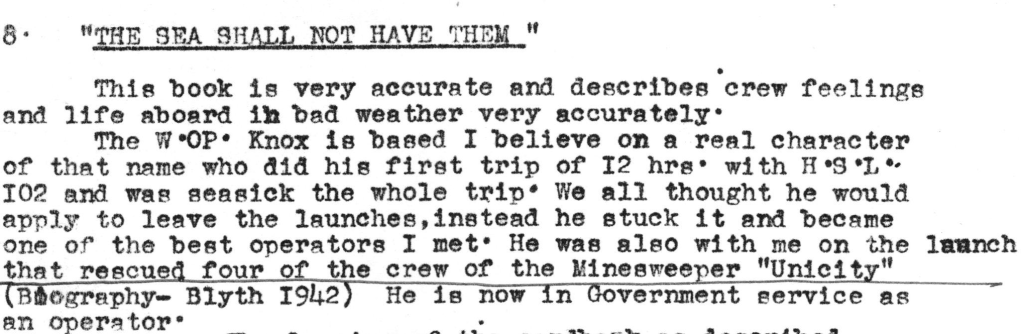
So Lofty stuck it, and became a good friend of Dad’s, sharing several boats and surviving a number of adventures. One night as they headed home in a howling gale from a call-out off Whitby, Lofty was twice thrown clean out of his wireless cabin. On another occasion, the launch was drifting in a fog with the skipper and the coxswains pouring over the chart trying to get a better idea of their position than ‘somewhere southeast of Middlesbrough’. Lofty came on deck for a breath of foggy air and for a brief while silence replaced the clicks, buzzes, squeaks and whistles that were his normal accompaniment to his life at sea. Then from across
the water came a low moaning and he ducked inside the wheelhouse and with a quick grin said:
‘Were a bit south of Whitby Skip, I just heard the Bull.’
The Skipper snarled back: ‘Who’s bloody Bull?’
‘Well kind of ours Sir.’ said Lofty,‘Mine and my Dad’s; come and listen.’
Outside, after a short pause, they heard the distant drone of a foghorn. ‘It’s the Whitby lighthouse,’ said Lofty. ‘Locals call it the Bull and my Dad used to be its keeper.’
In July of 1941, the unit received the seal of royal approval. The King and Queen were visiting Blyth to inspect the fitting out of the ‘Woolworth’ aircraft carriers (ships equipped with a launching ramp to enable them to catapult off a fighter aircraft for the protection of convoys). The RAF boats lay close to the carriers with their crews drawn up in front, in ‘best bib and tucker’ but the schedule for the royal couple did not include a visit to the unit. Everyone was therefore surprised when the King walked over, looked down on 102 and 118 and requested he be shown over one. Leaving the Queen on the jetty, about a yard from Sergeant Yorke, the King clambered down the ladder (I hope they had cleaned it) and stepped aboard the launch in the inner berth. It must have been 102. Why else in 1996 would the Queen, now the Queen Mother, have agreed to re-launch the fully restored HSL 102?
By the autumn a second generation of RAF ASR boats was coming into service and my Dad transferred to the crew of ‘Whaleback’ 133. These boats, also from the BPBC family, were yet another variation of the hard chine planing hull. Slightly shorter than the 200 class being 63ft loa, they were very pretty to look at and much beloved by their crews. They were not yet, however, purpose designed but modified Motor Anti Submarine Boats (MASB’s) and provided only a marginal improved layout. Meanwhile, back at BPBC George Selman (their chief designer) was already working on a third generation boat, purpose designed for rescue. By taking full account of all the lessons learnt from trailblazers like 102, Selman produced the 68ft HSL (nicknamed the ‘Hants and Dorset’) a design which truly fitted the needs of ASR.
102 remained with No. 15 ASR at Blyth for some time yet but the writing was on the wall. Soon 102, in need of another refit, was despatched to Felixstowe. Here (according to Cliff Woolard who joined her crew there as a fitter) she was known affectionately as the ‘Beast’. Cliff went with her when she transferred to Newhaven the following year. He was with her still when they took her to Brightlingsea and handed her over to the Navy. Cliff saw her one last time when he was in a crew ferrying 103 from Calshot to Cornwall. By then 102 had been painted battleship grey and was being used by the Navy for target towing. Sometime later, she entered her dark ages as a houseboat. Nearly fifty years later Phillip Clabburn found her rotting in the mud of the river Dart and nursed her back into vigorous good health. Dad and I visited her during her restoration, but Dad died a month before her re-launch. She can now be found and indeed chartered, at the Gun Wharf in Portsmouth in the care of Boathouse 4.
She was, said Dad:
‘Always a good boat, fast but wet; whenever she was slipped, screws could be withdrawn from her stern between finger and thumb.’
Now, beautifully restored, she is in The National Historic Ships collection at Portsmouth.
Reading list:
- Beardlow K: ‘Sailors in the RAF’.
- Andrew R. B. Simpson: ‘Another Life – Lawrence After Arabia’.
- Pilborough G.: ‘History of R.A.F. Marine Craft’.
- : ‘Royal Air Force Rescue Boats of World War Two’.
- Sutherland J. + Canwell D.: ‘The RAF Air Sea Rescue Service 1918 -1986’.
- Phelan K. + Brice M.: ‘Fast Attack Craft’.
- Fock H.: ‘Fast Fighting Boats’.
- Rance A.: ‘Fast Boats and Flying Boats (A biography of Hubert Scott-Paine)’.
 ASR Whaleback S32